Being locked out of your home is probably one of the most stressful situations that can happen to you, but with a little calm and a few simple steps you can avoid damage and come out on top. We have spoken to locksmiths who have given us clear advice so that you can act safely. In this guide you will find: practical and safe instructions for getting in, what not to do so as not to make the situation worse and when it is better to call a professional locksmith.
Contents
Quick summary and key steps
Check this before trying anything
Safe methods to open a door that is not locked with the key
Methods you should never use
When to call a professional locksmith
Guide prices and what to ask for in the quote
How to stop it happening again
Frequently asked questions (FAQ)
1. Quick summary and key steps
Before you lose your patience, if you are locked out, check the following: 1) whether the door has some play or is firm; 2) if it has some play, try a rigid card or a thin sheet 3) if it is locked with the key or there is a risk, do not force it and call a locksmith.
2. Check this before trying anything
Even if they seem obvious, when you find yourself in this situation and you are nervous or angry it is easy to overlook the most obvious things, so before touching anything, check:
Press the door lightly: if it moves, the door is ajar; if it is rigid, it may be locked with or without the key. Try the methods in point 3 first.
Try to get in through another entrance: back door, garage, an accessible window.
Ask relatives or neighbours: they might have a copy of the key or could lend you a card or an X-ray film to open the door.
Assess the risk: if there are children, elderly people or pets, do not take risks and call a professional.
A small practical note: in winter some doors can “swell” with the damp, making them hard to open with the key. This is because when they swell, the latch or the lock cylinders become misaligned with the holes in the frame and do not close or open properly. Try holding, pushing or pulling the door handle while turning the key to line up the latch and the hole in the frame for a moment. This can also happen if the hinges loosen or the door becomes uneven.
3. Safe methods to open a door that is not locked with the key
Try these methods if you cannot get another copy of your key and you are sure it is not a problem of the lock being misaligned or the door being locked with the key.
Rigid card
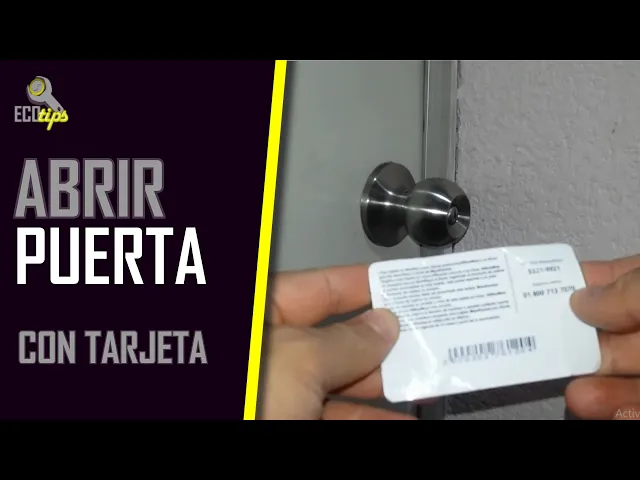
As long as the side of the frame and the door are aligned, insert a rigid card that is not a bank card between the frame and the door below the lock. Slide the card upwards and backwards to push the lock latch out of the hole in the frame and push the door.
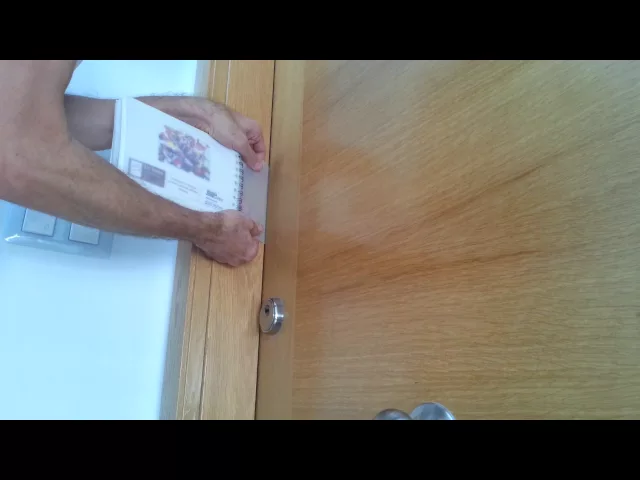
Using an X-ray film or a thin sheet
In this case the side of the frame and the door may form an angle. The sheet must be flexible enough to bend around the angle, but rigid enough to move the latch. Use the same movement as in the previous step.
Safe alternative entrance
If there is a window or back door you can reach without risk, consider that option before forcing the main door.
Contact the owner or the building management If you rent, the owner or the residents’ association usually has a copy. It is the quickest option and it costs nothing.
4. Methods you should never use
Unless you are an expert locksmith, I recommend that you never use these methods:
Hitting or kicking the door — it damages the frame and the lock.
Using metal tools without experience — you can break the cylinder or leave pieces inside.
Improvised hooks — they can jam the mechanism.
Using your bank card — it can break and get stuck inside, as well as the risk of losing data.
Forcing a door can multiply the final cost of the repair. I say this from experience: I have seen frames left useless by a hasty attempt.
5. When to call a professional locksmith
Call if: the door is locked with the key, the lock is a security lock (double lock), there is a risk to people or pets, or the simple methods do not work. A professional will open the door with the right tools and, if necessary, will replace the cylinder without damaging the frame.
6. Guide prices and what to ask for in the quote
Prices vary by city and time of day. Always ask for a breakdown: labour, call-out and parts.
Service | Guide price | What to ask for |
Opening a door that is ajar | 60–90 € | Confirm that it is without damage |
Opening a door locked with the key | 90–150 € | Say whether it includes replacing the cylinder |
Cylinder replacement | 70–150 € | Brand and guarantee of the cylinder |
Opening a security door | 120–250 € | Confirm the method and the guarantee |
Practical tip: always ask for an invoice and a written guarantee; a surcharge usually applies for night-time emergencies. If you are given a very low price over the phone, be wary: it may be a hook to then charge you extras.
7. How to stop it happening again
Stop it happening again with these simple measures:
Leave a copy of the key with a relative or a neighbour you trust.
Use 3-in-1 oil from time to time so that the latch and the cylinders slide smoothly.
Install a cylinder with an inside knob so you can lock from the inside without a key.
Put a visible key hook near the door (always out of public view).
Check the lock once a year and replace worn cylinders.
Consider a lock with key copy control if you live on the ground floor.
8. Frequently asked questions (FAQ)
Q: Can I open a security door (double lock) without a key? No. Security doors are designed to prevent unauthorised opening; it requires a professional locksmith with specific tools.
Q: Is it legal to open my own door without a key? Yes, as long as it is your home. Do not try to open other people’s doors or the common areas of the building.
Q: How long does a locksmith take to arrive? During normal hours, between 15 and 90 minutes; for 24-hour emergencies it may vary depending on availability and distance.